

Symptoms

The meaning of the common cold and rhinitis according to the 5 Biological Laws

Andrea Taddei4 min read
The meaning of the common cold and rhinitis according to the 5 Biological Laws

To truly understand the common cold and rhinitis according to the 5 Biological Laws, we need to start from a fundamental principle: what we usually call disease is not a mistake of the body, but a meaningful biological process. Every symptom has a precise function and responds to a real cause, often of an emotional nature.

According to the five biological laws discovered by Dr. Hamer, the organism reacts to a sudden shock, experienced intensely and unexpectedly. This event triggers a simultaneous response on the psychic, cerebral and organic levels, involving the functioning of the tissues and of the organ concerned. It is a holistic approach that allows us to analyse the symptom in a deeper and more practical way, going beyond the purely symptomatic view of conventional medicine.

The real cause of the common cold

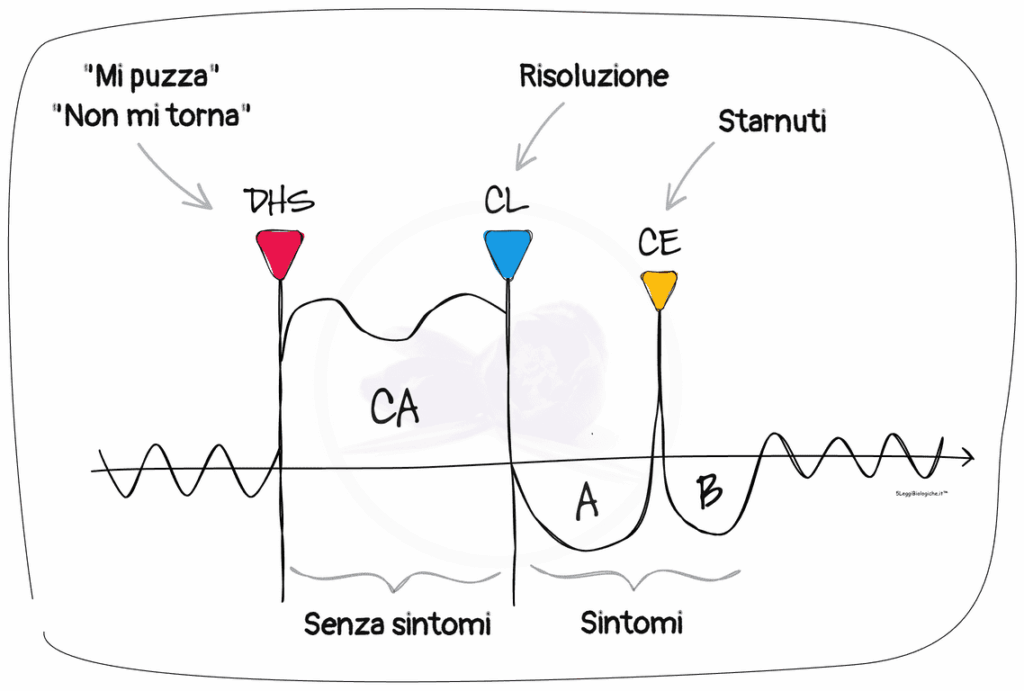
According to the 5BL, the onset of a cold is not caused by viruses or by the cold weather: it represents a healing phase. At its root lies the so-called stink conflict, which Dr. Hamer also described in several lectures and medical-scientific papers.

The nose and the paranasal sinuses, part of the respiratory system, are linked to a very ancient biological perception: “something stinks”. It may be a situation at work, in a relationship or in the family that is experienced as intolerable, threatening or unpleasant. Emotions such as guilt, unease or distress can also have a strong emotional and biological impact.

In this sense, emotional reactions can lead to a concrete response from the body. The cold, sinusitis or rhinitis thus become a meaningful biological reaction.

Active phase: what happens before the symptom

During the active phase of the conflict, the mucous membrane of the nose and of the paranasal sinuses undergoes micro-ulceration. This happens without noticeable pain, and often without the person even realising it.

From a physiological point of view, the ulceration has a precise purpose: to widen the nasal passages so as to “smell” the danger better. It is a biological adaptation that fits perfectly into the biological process described by the New Medicine. In this phase the nose is dry, crusts may form and the disorder often goes unnoticed.

Resolution and healing phase: the onset of the cold

When the conflict is resolved — that is, when the situation that “stank” loses intensity or is overcome — the body enters the resolution phase. This is when the cold actually appears.

The mucous membrane regenerates, swells and produces mucus to repair the tissues. It is in this phase that the best-known symptoms appear:

  • Blocked nose and congestion, typical of rhinitis
  • Abundant mucus: clear if more recent tissues are involved, yellow or thick if older ones are
  • Sneezing, which marks a peak in the healing process
  • Sinus headache, linked to cerebral oedema
  • Fever, which helps speed up the repair
  • Tiredness, a sign that the nervous system is in recovery mode

None of these signs are the disease: they are the symptom of a healing that is under way. Disorders such as bronchitis, asthma or problems of the bronchi follow the same biological principle too.

Relapses, allergies and biological tracks

When a cold or rhinitis keeps coming back, it is not a chronic problem but a series of relapses. According to the 5 Biological Laws, every relapse is the result of the conflict being reactivated through a track.

A track can be a smell, a season, a place, pollen, smoke, perfume or animal hair. These traces are often interpreted as allergies, but in reality they are biological associations stored at the moment of the first shock.

Classic hay fever, for example, is a response of the mucous membranes triggered by a specific track, not a weakness of the immune system.

A new way of looking at your health

Understanding the common cold according to the 5 Biological Laws means learning to examine the reasons behind an illness without blaming yourself. It means observing your own reactions, the emotional context and the moment in life when the symptom appears.

Taking care of your health also means slowing down, meditating, listening to yourself and choosing more positive environments and people. This approach does not exclude medicine: it integrates it into a broader, more conscious vision that respects the body.

Knowing in order to understand

Through careful, in-depth study, I offer training courses on the 5 Biological Laws so that you can discover how the body responds to the events of life.

A cold is not an enemy to fight, but a message to understand. Only in this way can we support healing, prevent relapses and develop a more conscious relationship with our own organism.

Keep reading

All articles